

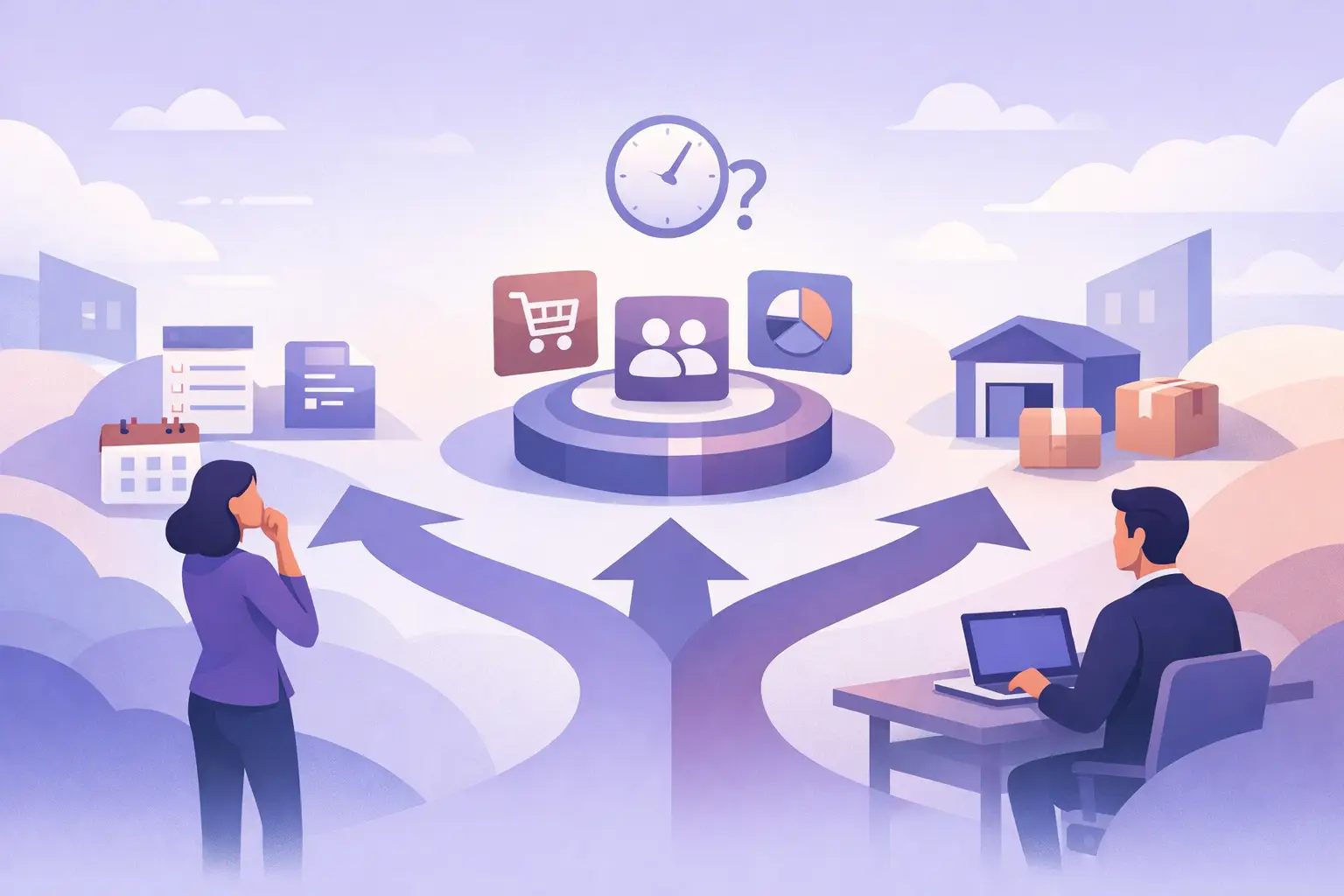
Most companies do not move to Odoo because they woke up inspired by ERP software. They move because the current setup is starting to cost real money, real time, or real credibility.
That is the right frame for the question of when should businesses move to Odoo. Not when the demo looks nice. Not when someone on the team is fed up with spreadsheets. The real answer is: move when your current tools are creating operational drag that leadership can see, quantify, and no longer defend.
When should businesses move to Odoo? Start with operational pain
If your team is stitching together accounting software, a CRM, inventory tools, email threads, and a few heroic spreadsheets, you already know the pattern. Sales closes a deal, operations retypes it, finance fixes the invoice, and leadership gets three different versions of what happened.
That setup can work for a while. Small teams often survive on hustle and tribal knowledge. But once the business grows past a certain point, disconnected systems stop being annoying and start becoming a control problem.
Odoo makes sense when the issue is not just missing features. It makes sense when the business needs one system to carry process across departments, with cleaner handoffs, fewer manual workarounds, and reporting people can actually trust.
A few signs matter more than others.
Your team is doing duplicate work everywhere
This is usually the clearest trigger. If sales enters customer data in one place, accounting re-enters it somewhere else, and operations keeps its own records because nobody trusts the first two, you are paying people to maintain system gaps.
That is not just inefficient. It creates errors that show up in missed shipments, wrong invoices, delayed approvals, and messy month-end closes. Once duplicate work becomes normal, moving to Odoo starts looking less like a software decision and more like basic operational cleanup.
Reporting takes too long and still starts arguments
A lot of companies think they need better dashboards. What they actually need is a system that stops creating conflicting numbers.
If your executive team cannot get a clean answer on pipeline, inventory status, project margin, receivables, or fulfillment performance without pulling data from four places, you are probably late to the conversation. Odoo is a good fit when reporting is slow because the business is fragmented, not because your team lacks effort.
Growth is exposing process cracks
Five employees can get away with memory. Fifty cannot. A second warehouse, a new service line, recurring billing, multi-entity accounting, or more complex approval flows can turn a passable setup into a daily headache.
This is where timing matters. The right time to move is often just before those cracks become outages. If you wait until every department is already underwater, the ERP move gets harder because people are trying to redesign the plane during turbulence.
The wrong reasons to move to Odoo
Not every messy business should start an ERP project tomorrow. Some companies reach for Odoo because they are frustrated, but frustration alone is not a migration plan.
If your processes are undefined, ownership is fuzzy, and no one can make decisions about how work should flow, Odoo will not fix that. It will document the chaos more efficiently. Software is very good at making bad process official.
It is also a mistake to move because one department wants a shiny replacement for a tool they dislike, while the rest of the company is not bought in. Odoo works best when leadership sees it as an operating model decision, not a side project for one team.
Another bad reason is trying to save a failing implementation budget by under-scoping the work. Companies do this all the time. They delay discovery, skip cleanup, avoid change management, and assume users will figure it out after go-live. Then everyone declares ERP software terrible, when the real issue was predictable: the business tried to cut corners on the part where reality gets mapped.
When timing is actually right
There is a difference between needing Odoo and being ready for Odoo. Good timing usually has three things in place.
First, the pain is clear. Leadership can point to specific breakdowns such as delayed invoicing, inventory errors, slow closes, missed follow-up, disconnected fulfillment, or poor visibility across departments.
Second, there is internal ownership. Someone on the business side has authority to make decisions, resolve conflicts, and keep momentum. An ERP project without internal ownership becomes a consultant-led guessing exercise, which is expensive and usually dumb.
Third, the company is willing to standardize. Not everything should be customized. If every team insists that its current weird process is sacred, the project will drag and the system will become harder to maintain.
That does not mean forcing the business into a box. It means being honest about where process should adapt to the platform and where the platform should adapt to the business. Mature companies can make that distinction. Exhausted companies often cannot.
When should businesses move to Odoo instead of replacing one tool at a time?
This is the comparison that matters. Sometimes replacing one weak tool is enough. Sometimes it is just another patch on a system that is already too fragmented.
If your pain is isolated, a targeted replacement can be sensible. Maybe your CRM is weak but accounting, inventory, and operations are stable. Fine. Fix the narrow problem.
But if the same customer, order, invoice, project, or inventory record is bouncing between multiple systems and teams, replacing one app at a time usually prolongs the mess. You end up with a nicer version of the same broken architecture.
That is when businesses should move to Odoo: when the real problem is coordination across the business, not dissatisfaction with a single tool. Odoo earns its keep when integration and shared process matter more than any one department getting its favorite app.
Industry-specific triggers we see most often
The pattern changes a bit by industry, but the underlying issue is the same.
For e-commerce teams, the move usually becomes urgent when order volume grows faster than operational control. Inventory mismatches, delayed fulfillment, return chaos, and disconnected customer data are common triggers.
For manufacturers, the pressure tends to show up in planning, purchasing, bills of materials, shop floor visibility, and cost tracking. Once production data lives in one place and finance lives in another, trust erodes fast.
For professional services and SaaS companies, the trigger is often revenue visibility. If proposals, delivery, invoicing, retainers, time tracking, and renewals are managed across separate tools, margin gets blurry and forecasting gets political.
For nonprofits, the pain often sits in donor management, events, finance, approvals, and reporting to boards or funders. Manual reconciliation is usually the hidden tax.
What businesses underestimate about the move
Most companies underestimate data cleanup and change management. Not the software. Not the license. The human and operational mess in the middle.
Old systems contain duplicates, bad conventions, abandoned fields, stale contacts, and workarounds people forgot they created. If you move junk into Odoo, you do not get transformation. You get organized junk.
Teams also underestimate how much process clarity is required before configuration starts. If two managers describe the same approval flow differently, the issue is not technical. The issue is unresolved operations.
Then there is go-live timing. Many businesses try to launch during peak season, during a major website relaunch, near year-end close, or in the middle of a staffing transition. That is asking for avoidable pain. The best ERP projects respect the business calendar and the business capacity, not just the implementation timeline.
A simple test for whether it is time
Ask four direct questions.
Are we paying people to re-enter or reconcile data across systems every week?
Do leaders lack confidence in core operational numbers?
Are growth plans being slowed by process limitations rather than sales demand?
Would one accountable system materially reduce risk across sales, finance, inventory, fulfillment, or service delivery?
If the answer to three or four is yes, the move is probably justified. If the answer is one vague maybe and the rest are complaints about user interface preferences, wait.
That is the practical standard. ERP should solve operational risk, not boredom.
The move works better when support does not disappear after go-live
This is the part too many firms gloss over. Odoo is not a one-time installation. It becomes part of how the business runs, which means support, iteration, testing, documentation, and ownership still matter after launch.
The same companies that are tired of fragile WordPress setups usually feel the same frustration with ERP vendors who vanish once the implementation is technically done. Go-live is not the finish line. It is the point where the system starts touching real deadlines, real staff habits, and real accountability.
That is why the best time to move is when the business is ready to treat Odoo like an operating system for the company, not a project to cross off a list. If you approach it that way, the payoff is not just cleaner software. It is fewer handoff failures, better visibility, and a business that spends less time arguing with its own tools.
If your team is already compensating for bad systems with extra labor, extra checking, and extra meetings, you are not saving money by waiting. You are just paying for the problem in smaller, less honest increments.
Want WordPress to feel handled?
Self-serve onboarding takes minutes. Parameter takes care of the rest — hosting, ops, and improvements when you need them.