

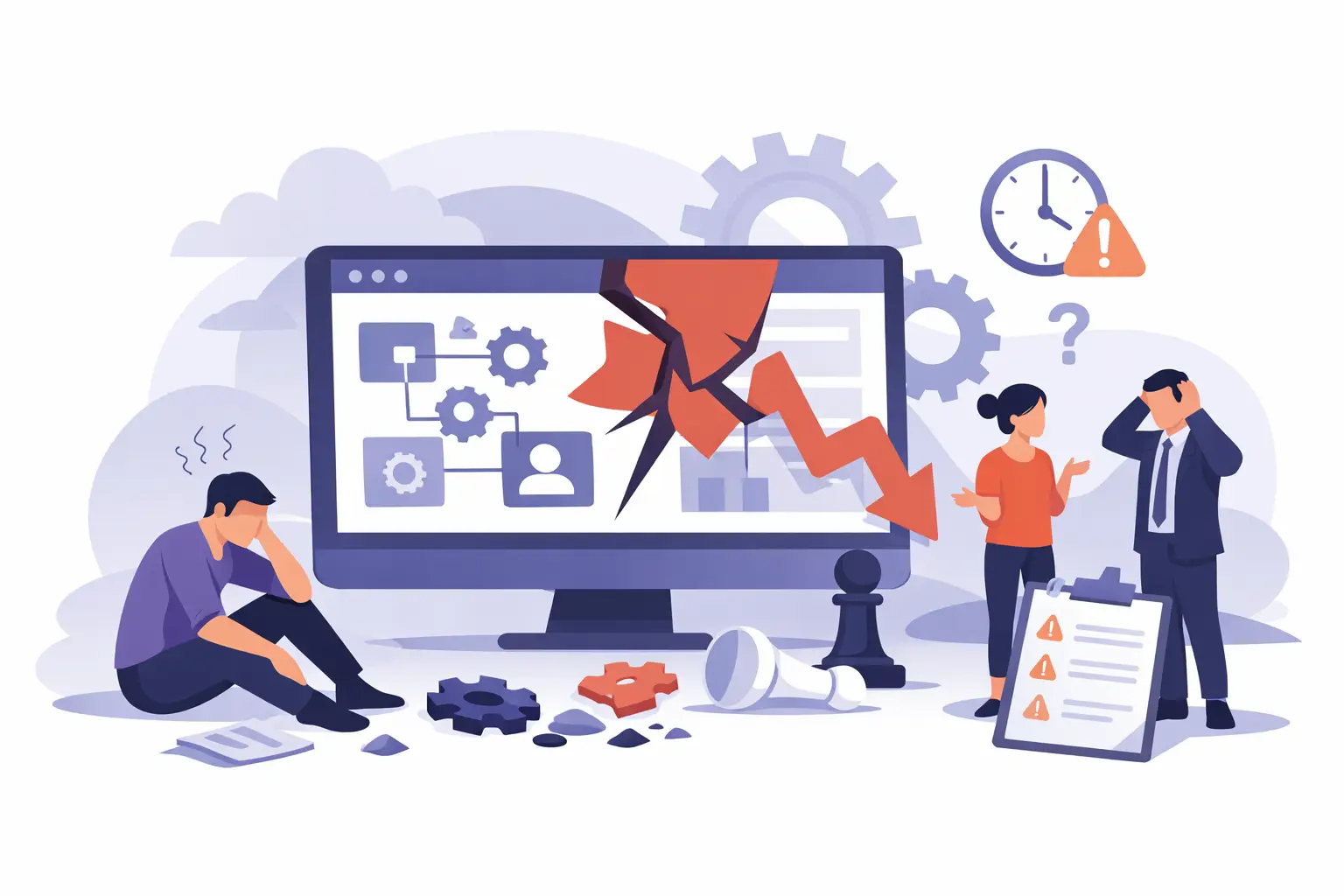
Most Odoo failures don’t start with software. They start with wishful thinking.
A company buys Odoo to replace spreadsheets, disconnected apps, and a few heroic employees holding the whole operation together. Six months later, the team is behind schedule, reporting is wrong, users are bypassing the system, and leadership is asking whether they picked the wrong platform. That’s usually the moment the real question shows up: why does Odoo implementation fail when the demos looked so clean?
The short answer is this: Odoo implementations fail when businesses treat ERP like a website redesign instead of an operating model change. The software matters, but the bigger issues are scope, ownership, process decisions, data quality, and what happens after go-live.
Why does Odoo implementation fail in real companies?
It usually fails long before anyone says the project is failing. The early signs are subtle: vague requirements, too many custom requests, missing process owners, and a timeline built around optimism instead of capacity. By the time the system is live, those small decisions have stacked into a very expensive mess.
Odoo is flexible, and that’s part of the problem. Flexibility is useful when you know how your business should run. It becomes dangerous when the implementation team uses customization to avoid hard decisions. If every department wants the system to mirror its current habits exactly, the project turns into a museum of old workarounds.
That’s why failed implementations often have the same shape. The software is blamed, but the root cause is usually operational. The business never got aligned on what the system was supposed to standardize, who owned each workflow, and what tradeoffs were acceptable.
Bad scope is the first crack
A lot of ERP projects are approved on broad language. Improve inventory. Fix reporting. Streamline accounting. Give sales better visibility. Those goals are reasonable, but they are not scope.
Real scope defines which modules are included, which processes are changing, what integrations are required, what data must be migrated, and what success looks like by phase. Without that level of detail, every meeting becomes a moving target. Teams start adding “one more thing,” and partners start building around assumptions.
Odoo can cover CRM, accounting, inventory, manufacturing, subscriptions, helpdesk, and more. That range makes it tempting to do everything at once. For some companies, that works. For many, it creates a bottleneck where one unfinished area holds up the entire launch.
The smarter move is often phased delivery with hard boundaries. Not because phased projects are automatically safer, but because they force decisions. You find out what truly matters to the business and what can wait 60 or 90 days.
Customization gets approved too easily
Here’s a common pattern: a team sees a gap between how Odoo works out of the box and how they currently operate. Instead of asking whether the current process is worth preserving, they ask for custom development.
That’s where costs and risk start to climb. Some customization is justified. Manufacturing, advanced pricing, regulated workflows, and industry-specific approvals can require it. But too much custom work makes testing harder, upgrades slower, training more confusing, and support more expensive.
If your implementation requires custom code to reproduce every quirk of your old process, you are not implementing an ERP. You are rebuilding your bad habits in a new interface.
Weak ownership kills momentum
ERP projects do poorly when they are everyone’s priority and no one’s job.
A successful Odoo rollout needs executive sponsorship and operational ownership. Those are not the same thing. An executive can remove roadblocks and make decisions stick. An internal process owner has to define workflows, resolve department conflicts, validate outcomes, and keep the team engaged.
When ownership is weak, projects drift into committee mode. Sales wants flexibility, finance wants control, operations wants exceptions, and nobody is empowered to decide what the system should actually do. The implementation partner ends up mediating internal politics instead of building a reliable system.
This is especially common in growing companies that have outgrown the “just ask Karen” phase but haven’t formalized process ownership. Odoo exposes that gap fast. Software is very good at showing where accountability was previously held together by memory and hallway conversations.
Dirty data makes good systems look broken
If the data going into Odoo is incomplete, duplicated, outdated, or structurally inconsistent, users will assume the system is bad. They won’t say, “Our item master was a disaster.” They’ll say inventory is wrong and stop trusting the platform.
Data migration gets underestimated because it sounds administrative. It is not. It’s operational risk management.
Customer records, vendors, products, chart of accounts, BOMs, pricing rules, taxes, open invoices, and historical transactions all have to be reviewed with intent. Not every old field deserves to survive. Not every legacy record should move over. A clean implementation often starts by deleting more than expected.
Reporting breaks where definitions were never agreed on
Executives usually want better reporting from day one. Fair enough. But many companies have never agreed on basic definitions behind the metrics they care about.
What counts as a qualified opportunity? When is revenue recognized? How is work in progress valued? Which inventory adjustments are operational versus financial? If those definitions are fuzzy before migration, Odoo will not magically settle the debate. It will just make the disagreement visible in dashboards.
Training is treated like a calendar event
A two-hour training session before go-live is not adoption. It is theater.
Users need role-based training tied to real tasks, real exceptions, and real consequences. A warehouse team needs different training than accounting. A sales manager needs different context than a purchasing coordinator. If everyone gets the same generic walkthrough, they will forget most of it by next week and invent side processes by next month.
Training also has to include the why. People are more willing to change when they understand what the new process protects. Faster closes, fewer stockouts, cleaner audits, less manual rework, fewer customer errors. If the team only hears “this is the new system,” resistance is predictable.
And yes, some resistance is political, not practical. ERP removes ambiguity, and some people are very attached to ambiguity.
Go-live is treated as the finish line
Another answer to why does Odoo implementation fail is simple: the partner disappears after launch, or the client expects steady-state operations from a system that hasn’t earned them yet.
Go-live is not proof of success. It is the start of production use. That’s when edge cases appear, adoption gaps become obvious, and reporting issues hit leadership. If there is no structured support period, no backlog for fixes and refinements, no monitoring of what users are actually doing, the organization slides into distrust.
Good post-launch support is boring in the right way. Issue triage, documented fixes, controlled changes, user feedback loops, reporting validation, and a clear owner for the next round of improvements. Not chaos, not heroics, not random Slack messages at 9:40 p.m.
For companies that rely on ERP for fulfillment, finance, or manufacturing, this matters even more. A shaky Odoo environment creates the same business risk as a shaky production website. Different stack, same problem: nobody wants to explain to leadership why a preventable systems issue blocked revenue.
The implementation partner can be part of the problem
Not every failed project is the client’s fault.
Some partners oversell timelines. Some underprice discovery and make it up in change orders. Some say yes to bad customization because saying no is uncomfortable. Some are strong on technical setup and weak on business process design. Some are fine at launch and poor at ongoing support.
A capable partner should challenge assumptions, push for decisions, document tradeoffs, and keep customization disciplined. They should also be honest when a request adds complexity without adding value. If your partner acts like a ticket taker, you may get exactly what you asked for and still end up with a failed implementation.
How to avoid the failure pattern
The fix is not mysterious, but it does require discipline. Start with process discovery that is grounded in actual operations, not aspirational org-chart language. Define scope by workflow, owner, dependency, and phase. Be selective about customization. Treat data cleanup as part of the implementation, not prep work someone will “handle.”
Then plan for adoption like it matters, because it does. Train by role. Test with real scenarios. Keep a post-launch support window with clear accountability. Measure whether the business is actually using the system the way it was designed.
If you want a cleaner rule, here it is: Odoo works better when the business is willing to standardize what should be standard, customize only where it earns its keep, and operate the system after launch with the same discipline it expected during the project.
That’s the part many teams skip. They buy implementation, but what they needed was implementation plus operations.
A successful ERP is not the one that goes live fastest. It’s the one your team still trusts six months later.
Want WordPress to feel handled?
Self-serve onboarding takes minutes. Parameter takes care of the rest — hosting, ops, and improvements when you need them.